Spyforce Needs to Go

I’ll freely admit it: I’m a bad activist. I don’t write letters as much as I should, and I don’t promote things when I first hear about them. I do personal boycotts, but (as I’ve stated before) I don’t think that’s enough. So it should come as no surprise that I’ve known about StarForce for quite some time. I did the obligatory check on my computer, vowed never to let that shit onto my hard drive, and promptly forgot about the whole thing.

That is, until I narrowly escaped having that piece of nasty spyware ruin my ability to experience the sequel to The Longest Journey. You see, Guilded Lilies reminded me to check the Starforce list again and, lo and behold, Dreamfall appeared on the list of infected games.

Please take a moment to imagine my reaction. I’ve been waiting for this game since 1999 and now some piece of crap company who supports a program that has been known to do irreparable harm to computers was going to ruin that! It got to the point where I was thinking, “You know, I bet there’s a cracked version out there that doesn’t include that POS virus spyware.” Crazy, I know. But you don’t understand how much I love this series.

So, anyway, I then went into denial mode. “Just because GameFaqs lists this as the only hit for ‘dreamfall’ there must be another game. The beloved creators of The Longest Journey simply would not do that to me.” The bad news is that yes, yes they did. The good news is that only the people who buy the UK or Limited edition are screwed. Aspyr, the US distributor, uses a different kind of copy-protection.

So, instead of the angry letter I intended to fire off, I wrote an encouraging one:

As an avid gamer and long-time fan of The Longest Journey, I was excited (to say the least) when I saw that the sequel had finally come out. Imagine my shock when the game appeared on the list of games that came with Starforce!

After a little bit of digging, I was relieved to find that your version of the game did *not* include the program. So, I was just writing in with my support for the decision. I don’t know if you did it because of the boycott or another reason, but I am glad that I don’t have to miss out on the sequel to one of my all-time favourite games.

Information about the Starforce boycott can be found here.

As long as Aspyr games continue to stay clean of that nasty piece of spyware, you can be sure that I will keep my eye out for your new releases.

If any of y’all are fans of The Longest Journey I encourage you to fire off a little note to the company giving them your support both for the product and for their decision not to use Starforce.

PS: I blame my love for Dreamfall for my inability to read. GL says right in her post that Aspyr Media made the decision to pull Starforce from their games.

Boycott Staforce

Better a fair-weather ally than not an ally at all?

In response to the “nice guy” controversy that Hugo has sparked in the feminist blogsphere, Mickle has made an excellent post titled Masquerade. She talks about politeness, sincerity, and what it means to be an ally.

These paragraphs really resonated with me:

I can’t help but think of this when people argue for politeness for politeness sake and I wonder about the people he was polite to – in public. Did they suspect? Would they rather have known the truth? Could they sense it anyway? Did they resent the fact that the mask of politeness my grandfather hid behind made it that much harder to fight his bigotry? Were they sometimes grateful that his mask made theirs that much easier to wear? Did they apprecraite the irony that it was their honest anger that forced him to adopt the masquerade they had always been forced to be a part of?

I understand that you can catch more flies with honey than vinegar, I just think people need to remember that allies gained under false pretenses tend to make shitty allies. Individuals for whom the deciding factor in their political and ideological beliefs is the number of times they may get laid do not make good feminists. Being bluntly honest may be a bit “off-putting” but it’s still more likely to result in a useful ally. After all, non-violence may have been a hallmark of the civil rights movement, but “polite” discourse was not. “Polite” conversation doesn’t include discussions about race to begin with – and “polite” sure as hell doesn’t describe the act of holding a lunch counter hostage. I rather think a hell of a lot of people considerd it downright rude at the very least.


Dividing to include, including to divide?

So, as y’all should know by now, I currently live in Japan, but I consider my home area to be the Washington and British Columbia areas. My mom lives there and she recently e-mailed me a news article about the formation of GLBT Month in Jefferson County. The reason she did this was because of one letter to the editor that angered her very much.

In a nutshell, Connie Rosenquist, the letter writer, is angry over Jefferson County’s decision to have a GLBT Month. My mother said that most of the responses to the original article were positive, but this negative one pushed her buttons for a reason she couldn’t name. I read it and knew immediately what it was; it was the same attitude that opponents of this proclamation in the original article expressed. An attitude that oppression activists are intimately familiar with.

I’m talking about privilege.

In this case, the ability to believe that one’s privileged state is the “default” and therefore see any attempt at equality as the non-privileged groups to get “special” rights, or to see them as trying to shut you out of “your” community. I’ve taken this on from the perspective of helping potential allies, but now I want to examine exactly why these attitudes are actually harmful to the expressed goals of equality, neutrality, and inclusion.

I. The Myth of Cultural Neutrality

“While I do agree we don’t want discrimination, I don’t believe it exists in the county,” he said, pausing as a handful of people present who opposed the proclamation applauded.

“I don’t believe government should be taking a position on any lifestyle,” Rodgers said.

[From Gay pride proclamation stirs controversy by By Kasia Pierzga]

The position that conservatives like Rodgers and Rosenquist are coming from is founded on the notion that society, as it is right now, is neutral. For those of us who fight oppression, this assumption is obviously fallacious — if one could major in fighting oppression, the idea that we live in a neutral society would be debunked in Privilege 101. But, for the majority of people, this idea remains unquestioned until they find that rights that matter to them come into question. And even then, the connection might not be made unless they happen upon an article, discussion, or class and the idea is not only brought up but done so in a way that resonates with them.

In other words, I’m surprised that any of us actually interact with notions of privilege and what it means in our respective societies given what we have stacked against us. I mean, who wants to think about how our society is crappy and that all of us, in our own special ways, contribute to the crappiness? I sure don’t! But I know if I don’t, not only will I suffer, but everyone else will, too. And, well, what’s worse than thinking about a crappy society is realizing that I’m willfully participating in hurting other people.
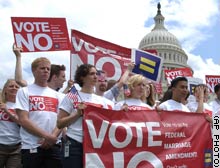
Not A Position On A LifestyleBringing this back to privilege and the myth of a neutral culture. One of the main ideas behind the concept of privilege is that our privileged state is seen as a “default” or “neutral” state in society. In regards to feminism, the main principle is that of “male normativity” — or seeing men, and the masculine sphere, as the default human state. For racial activism, the main state is “assumption: white” — meaning that white people are seen as the default human state, and white culture is seen as the default culture. In this case, the privileged state being battled is that of heteronormativity.

When Rodgers says that he doesn’t believe that the government should be taking a position on any lifestyle, he is clearly not counting heterosexuality as a “lifestyle.” For him, and those who hold the same beliefs, heterosexuality isn’t a lifestyle, it is simply a given in life. They are heterosexual, therefore everyone must be. The people who live outside of a traditional heterosexual lifestyle can’t be doing it it because it’s their default human state, but because they choose to live a different way.

But, I mean, the government is not staying out of people’s relationships. From the foundation of the United States of America, to the laws and regulations of America’s parent countries, and even looking at the way that the institution of marriage has developed and been practiced in nations throughout history, the government has always had a stake in this area. The whole point of marriage is so that the state can confer all sorts of applicable rights to the married persons.

Not only that, but the government is clearly not even neutral on the subject of queer relationships, but there is a strong minority force, lead by Bush, is all too involved in taking a position on the “lifestyle”. To be fair, Rodgers himself may be against this, too, but the point is that attacks like the repeated attempts to amend the constitution to ban same-sex marriage is a pretty clear case against the idea that our culture is neutral ground when it comes to heterosexual rights versus queer rights. Unless I missed the part where the senate voted on whether or not we should ban different-sex marriages.

II. Leveling the Playing Field

In her letter, Rosenquist calls the proclamation “unnecessarily offending and dividing.” Although she does not outright state it, I think it’s safe to infer from what she does say that one reason she believes this is because having a GLBT Month seems to confer “special” rights to a group of people. But that works from the assumption that heterosexuality isn’t already privileged over non-heterosexuality. The purpose of the proclamation is not to one up heterosexuality, but rather to level the playing field.

What do I mean by that? Isn’t the playing field already level? Well, not exactly. In fact, there are several different fronts on which heteronormativity gives heterosexuality a one up on other forms of sexual expression. To name a few:

Socalized Heterosexuality:
From the moment we are born until the moment we die, we are continually socialized. Girls become women while being constantly asked about boyfriends, husbands, and male crushes. Boys become men men while being constantly asked about girlfriends, wives, and female crushes. When we are taught in schools, it’s with teaching materials that reinforce “man + woman = couple.”

This doesn’t stop at grade school, but continues even into adult education. For example, in my Japanese class we watch videos that deal with a love triangle where two men like a woman they work with. The pictures our book uses sometimes depicts men and women out on dates. And, of course, in our class discussions everyone assumes everyone else is heterosexual — the women have to make example sentences about boyfriends, the men have to make example sentences about girlfriends.
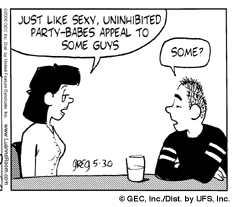
HeteronormativityHeterosexual Messages in Popular Culture:
Like the picture on the left, the assumption that all people are heterosexual is an unquestioned part of much of our popular culture. When you hear “romantic comedy” you think of a female lead who is lead through a serious of hilarious mishaps until she finds true love with her male counterpart. Action movies that have the obligatory love/lust sidestory will almost always have it set up as being the male lead getting it on with a female support character (or female lead, if the movie has that). Comics are… well, the insane amount of press that the new Batwoman is getting because she’s a lesbian (here, here, and here, to name a few) should be self evident.

And I’d say that this medium is where the queer community has made it’s largest strides in terms of combatting heteronormativity. Shows like Will and Grace, Queer as Folk, and The L Word — whether you like them or hate them — have been slowly creeping into popular culture. Sometimes even mainstream shows, like Buffy the Vampire Slayer, will have queer characters. Better yet, there is some tentative evidence to suggest that this promotes tolerance, yay!

But, while we have come a long way, it’s clear (to me, at least) that we still have a long way to go. Which brings me to my last example of heteronormativity in our daily lives.

Legislated Heteronormativity:
When I was talking about heteronormativity in Section 1, this is where I was focusing my efforts. Rodgers may have a point when he said that the government doesn’t have any business legislating sexuality, but making that case in terms of GLBT Month ignores the fact that the government has been in the business of legislating sexuality since before it was the American government.

Marriage laws, tax laws, inheritance laws, and up until recently sodomy laws — these are just a few ways in which the government has legislated our sexuality. And, guess what? For the most part they privilege heterosexual couples by lawfully legitimizing their union (a must have if your partner gets sick or dies) and even giving them monetary incentive in terms of tax breaks and, not as directly, cheaper insurance due to joint plans offered to people who have a legal marriage.

III. It’s Either Us, or Them

I’m going to go one step farther now and posit that the “neutrality” argument is a less overt way of claiming that any attempt to include the queer community in the American community is tantamount to pushing homosexuality on them. If the premise of a neutral culture were correct, then this argument would make a certain amount of sense because one set of values would get more attention than another. Even then, however, the either/or idea — that including one group means excluding the other — is a fallacious argument.

In her letter, Rosenquist employs a certain amount of the “can’t we all just get along?” rhetoric. When she calls the proclamation “unnecessarily offending and dividing,” it is apparently in the spirit of cooperation. That all of us — whether we be heterosexual or queer, conservative or progressive — can live together in a community. That’s a principle we can all get behind, right? Right?

But what kind of a community does she want us all to live in? I can’t answer that to the fullest extent, but I can extrapolate based on her letter. First of all, she believes that a community should make efforts to not offend its members or unnecessarily divide them. So far so good. But, when we get into what that seems to mean to her, things start getting hairy.

See, she feels that since the group is “self-defined by sexual practices,” GLBT Month will therefore not focus enough on the contributions of the nominees. The first problem with that argument is immediately apparent to anyone who knows what the “T” in “GLBT” stands for. That would be transgender. Until now, they have been largely excluded from the conversation — both by the Rosenquist and myself — because… well, because of a lot of reasons.
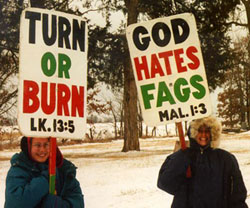
God Hates FagsOn Rosenquist’s end, I would wager that it’s because she is largely unaware of “trans issues” (I use the term very loosely), as most Americans are. For me, well, because I’m addressing the attitudes of the opponents. And also this post is long enough focusing mostly on issues of sexual orientation without getting into the diverse way that the “T” in “GBLT” interacts with the queer community. But, it’s important here because it is the most obvious way in which the queer community can be seen to be much, much more than a declaration of what genders we are attracted to.

Which brings me to my second problem with her oversimplification. It erases the fact that the reason we all have banded together is because we have been ignored, attacked, killed, deprived of our rights…. well, let’s get simple here, oppressed throughout history. Our sexual preferences may be one common thread between us, but it is not what I would call the “self-defining” feature of the queer rights movement. “The right not to be discriminated against, harassed, killed, or otherwise abused and excluded because of our sexual orientation, gender expression, sexual practices, etc.” would probably be closer to a self-defining feature, really.

And speaking of sexual practices, here’s another point I’d like to address. In her letter, she says:

Jefferson County has multitudes of ways to honor deserving people for actual contributions – and which spare us details of their sexual practices.

Reading this again, I am struck by the strong implication that queer-identified people haven’t made “actual contributions.” But in the interest of time and space, I’ll gloss over that and focus on one of the most telling parts of her piece. The part where she says that Jefferson County needs to honor people in ways that “spare us the details of their sexual practices.” Which, if we go back to her inclusive community idea, pretty strongly argues for the fact that the place queer people have in her community is, at best, that of eternal silence. Because anything else — even if it’s just talking about a same-sex partner in the same way that people talk about their different-sex partners — amounts to TMI.

And, lastly, let’s examine the part where she says:

A truly “welcoming” community also welcomes the more conservative.

Don’t forget that all of this is in response to the government trying to be inclusive of the queer movement by giving us one month out of the year in which we are honored for our struggles and other contributions that our members have made for the community. But, apparently doing this means that Rosenquist and conservatives like her are unwelcome.

“Unwelcome, how,” you ask? Do the queers go out and beat conservatives for daring to flaunt their heterosexuality? Do we try to pass laws that criminalize their unnatural different-sex-only attractions? Do we tell them that they’re welcome in our community only if they “spare us the details of their sexual practices”?

No, no. We make them feel unwelcome because we are, by our very existence, “unnecessarily offending and dividing.” We offend them because we challenge their heretofore unchallenged idea of heteronormativity. We are divisive because we’re different. But what they don’t get — perhaps don’t want to get — is that we can’t stop being who we are.

And if that makes them feel unwelcome… well, I don’t know what to else to say.


Reframing the Poly Debate

Four Legs Good, Six Legs BadPolygamy, polygyny, polyandry, polyamory, polyfidelity… By whatever label, using whatever configuration, the concept of poly is to involve more than two people in intimate relationships. In the Western world, this practice is mostly seen as immoral. The legal marriage of multiple partners is largely illegal, and the unquestionable “rightness” of this idea is used and abused by both sides when the concept of same-sex marriage comes up.

But I think that it’s time that we, as feminists, reframe this debate. We need to reach inside ourselves and ask why the idea of poly relationships feels wrong. What is it that makes the stereotype of polygamy objectionable? Is it the idea that monogamy isn’t the only healthy relationship style, or that the only example of poly relationships have been ones that traffic in women?

I. Challenging Deeply Held Beliefs

Like most Americans, I was brought up to believe that marriage was something that happened between a man and a woman. I don’t remember when the idea was challeged in terms of same-sex partnerships, but I distinctly remember when my belief that polygamy was inherently bad was called into question.

I was in high school at the time. Standing in my kitchen with someone — I forget if it was a family member or a friend — I think I was reading something about polygamy, but maybe it just came up randomly in conversation. I said something about polygamy being wrong. The person I was talking to countered with, “Why?”

I looked at them and blinked. Immediately I thought about the places in Utah where young girls are forced to marry older men. That’s what most of us think of first, isn’t it? But, a young girl being forced to marry a man is morally repugnant whether or not he’s done this to other women or not. And it is, for the most part, illegal whether it’s his first wife or fifth. Then… what? It just felt more wrong? Come on.

So I gave the only answer I could. I said, “I don’t know. Maybe it’s not.”

Since then, I’ve tried my best not to accept that something is one way just because that’s the way I’ve been taught it was. In the case of polygamy, the more I’ve learned about it, the more I realized that it was a lot more complex than the usual idea that it’s a bunch of old guys marrying underaged girls in Utah or the Middle East.

For instance, did you know that “polygamy” doesn’t actually mean that it’s a man with multiple wives (that would be polygyny), but can also be a woman with multiple husbands (polyandry)? Or that there’s a movement out there called polyamory (often referred to as “poly”)? A lot of people think that “polygamy” begins and ends with forced marriages of older men to younger women (not so different from traditional heterosexual marriage), and that therefore there is no other kind of configuration possible. But, if nothing else, polyamory tells a different story. There’s everything from Vs (one partner in the middle with two attached to hir), to triangles (all three partners connected to each other), to complex connections that end up forming a tight-knit community brought together by friendship, love, and sex.

II. Compulsory Monogamy

Good for the Goose, Good for the Gander?For some people, finding one person at a time to share their lives with is the only way to go. And, hey, if that’s your cup of tea, that’s great. But not everyone is like that. Just like not everyone is attracted to a different gender, or the same one, or any person at all, not everyone wants to be with just one person. It’s not better or worse, it’s just different. And it’s no more fair to say that everyone should only love one person than it is to say that only people of the same gender, class, race, etc. can love each other.

How can we fight against mandatory gender roles, heterosexism, racism, ablism, etc. and then go on believing that a romantic relationship can only exist between two people? How can we go on promoting this idea — either by our vocal assent or our conspicuous silence — and then expect our arguments against having other people’s ideals imposed on us to be taken seriously? I don’t think that we can.

If a relationship is filled with loving, consenting adults then what business is it of ours what configuration makes them happy?

III. Refocusing Our Efforts

Which brings me back to what I think is obscured by the “immorality” argument of polygamy: human rights abuses. Putting aside the problems we have a society recognizing and dealing with abuse (as that is a whole series of posts in of itself), when abuse is recognized in a heterosexual monogamous relationship, the configuration of the relationship is rarely, if ever, seen as the important factor.

Let me use this case from 2001, reported by CNN.com, as an example. The defendant was put on trial for bigamy and failure to pay child support. The article spends several paragraphs talking about Mormons and polygamy, and then ends the article with this:

The defense focused its efforts on parrying prosecution charges that Green married teenagers, divorced them and then collected their welfare payments as he continued living with them.

Green also faces a charge of first-degree felony rape of a 13-year-old girl with whom he allegedly had sex in 1986. He subsequently married the girl. The charge carries a prison term of five years to life, Reuters reported. A trial date is yet to be set.

What this article, and all the other ones like it that I’ve seen, have done is capitalize on the sensationalism of “Multiple! Wives! How Weird! And Thefore WRONG!” and either downplayed the way in which these women are used as chattel — taken, raped, and married as soon as they are biologically able to have children — or used them as a tool with which to strengthen the “wrongness” of mutiple marriage.

The suffering of these women should not be seen as evidence to support the case against polygamy, it should be treated as an important problem by itself. By making polygamy the main “evil” here, the focus is not on the actual harm being done but on the supposed immorality of non-monogamy. Furthermore, by using the abuse of women in a case against polygamy, it creates an idea that these kinds of things are unique to polygamy, instead of them being a greater narrative of traditional relationships of all kinds.

IV. Concusion

Love is... LoveAs feminists, I think that we can all agree that loving who we love is not wrong. I think that we can agree that people should be free to pursue happiness they way they need to as long as it doesn’t hurt others (a thorny subject, I know, but I think it’s a principle we can all get behind). I think we can agree that what happens between consenting adults is their business.


But, by allowing the debate about polygamy to be focused on mutliple-partnerships being morally wrong, all we’re doing is buying into the idea that one way — monogamy — is the best and only acceptable way. Not just that, but we’re also allowing the focus to be taken off the real atrocity: the trafficking of women. Traditional polygamy is no different than traditional marriage in this respect, and to allow oursleves to pretend it is is a disservice to the fight for women’s rights.


The virtues of being mouthy, talking back, etc…

I think this is the first time I’ve chosen to take a theme for a feminist carnival head on. When I first found out Bitch|Lab was hosting the next one, I was all set to write on sex positive feminism. First because this blog hasn’t had what can be considered an “upbeat” post in a while, and also because it’s an excuse to write on a subject that I don’t actually write about a lot. But her suggested theme about writing on the virtues of being mouthy caught my eye. I am, without a doubt, a mouthy author. Sometimes to the point where I have to put up an apology because my mouthiness crossed the line into viciousness.

Being mouthy is both liberating and infuriating. I say what I feel, how I feel it, but because it’s threatening — especially coming from a woman — it also means that, regardless of how right or wrong I am on an issue, I get hatred poured on me. There are times when I think it’s a virtue, there are times when I think it’s a curse, but, ultimately it’s just me.

This is who I am. I can no more change this about myself than I could stop breathing. And, furthermore, I’m proud of who I am. Even when it causes me pain to deal with the harassment I get, even when it causes me pain that I get called a facist because I don’t let people vomit all over my blog with their bile, even when I think to myself that this is what my life will be: an endless round of being smacked down by people who don’t like what I say and how I say it. Even then, I know myself. I know that I have to do what I think is right. And I know that it isn’t all about the bad.

I know there are people out there struggling the same way I do. Dealing with what I do. Maybe they’re stronger than me. Maybe they’re not. But if I didn’t fight, then how could I come to know these wonderful people? Blogging has brought me some of my best friends, it has brought me together with people who believe in doing what they believe is right. We’re all mouthy in our own ways. We don’t always agree. But this is a community we’re building. A solitary mouthy person is just one voice against the crushing tide of people who want to silence voices they don’t like, but a community of us is not so easily silenced.

And that, I think, is where the virtue lies. Call me what you like — mouthy, bitch, man-hater, etc. — but know that there’s nothing you can say to me to change who I am. I’m an outspoken feminist who believes in advocating for what she sees right. And I’m not the only one.


Moderation and Free Discussion

Ever since I’ve gone to moderation, I’ve gotten a lot of flack for it. Hell, even before going to moderation, I got a lot of flack for my discussion rules. Especially by the very people who flagrantly broke them and only received a warning. Recently, my blog was criticized as being “like 1984” with the implication that my discussion rules are in direct opposition to “open communication and free-thought.” All this said, of course, without knowing or caring about the history behind my choice to go moderated.

Do all of you honestly believe that the decision was made easy? That this is what I wanted from the start — having to wake up and pick and choose which comments can go through? I know this may be shocking, but it’s not my idea of fun to sit here and approve appropriate comments, delete the vicious attacks, nitpick the borderline comments, and then agonize whether my decision was wrong or not. I revise the rules as much as possible, to make it as clear as possible to me (and hopefully all of you) what will and will not make it through, but even then it’s hard for me to reject posts that deserve discussion because the person making them couldn’t be bothered to abide by all of the rules.

I’m going to talk about this once, and hopefully never again. I know it won’t stop the flames. It won’t stop the people out there who act all affronted that I’m somehow taking away their ability to have an “open discussion”. But maybe it’ll be something that I can look back on when these people make me feel bad, or for others to look at if they’re going through their own process of deciding what — if any — level of moderation is appropriate for their blogs.

Because, I’ll let you in on a secret. As much as having your comments moderated sucks, and moderating comments sucks, nothing sucks as bad as needing to moderate comments. And that’s something that I hope anyone who reads this post will understand.

I. Background: The Slow Road to Moderation

You see, this blog wasn’t moderated until about a month ago. It didn’t even have discussion rules until about six months after its conception. My original intent was for this place to be a safe space for discussion and personal growth. That remains my intent.

I’ve just had to learn some painful lessons to realize that I can’t have that without harsh moderation. Not with a feminist site, at any rate.

Maybe not even with a non-feminist site, as all the “true, open discussion” that the site my recent accuser comes from haven’t responded to my invitation to discuss what I said — here or there — with anything but more attacks, or in the best case scenario ignoring me completely to tell the OP how great she is and how she’s unequivocally right and I’m unequivocally wrong. That blog may be getting a lot of comments alright, but it’s having no better a discussion on the issue than I am over here.

But, anyway, back to the past. When I first started my blog, I didn’t want to have any rules at all. I believed, as many of you do, that the only way to have a true discussion was to have it free of modly interference. And it worked when my blog wasn’t known at all; when the only people who commented were friends or the few blog friends that I had made. And then I got into a debate with this random person who didn’t like one of my posts. After a lot of problems, I decided to draft my first discussion rules. They were more a guideline to myself than my posters, so the next time a problem flared up I could know how to handle it instead of sputtering and returning fire.

This mostly worked, but as I began gaining popularity I started getting pseudo-comment spam. After deleting one that had nothing to do with the post at hand except for a vague connection in subject matter, I got an angry e-mail from the poster about how I was censoring them. I tried to explain why it was inappropriate, and it ended with them ranting and raving at me and me not responding anymore. After that I clarified my guidlines and moved on.

Soon my posts were picked up in some feminist carnivals and highlighted on some of the more popular feminist blogs. That’s when my real problems began. You see, there are a lot of angry people out there who don’t like what I have to say. No, not even that. They don’t like that I’m a feminist who says things. It doesn’t matter what they are, because I’ve gotten flames on some of the most bizzare posts. I began to have people threatening me, dismissing me, cursing at me… and these began to overwhelm my threads. I know from experience that the few regulars I have would not be able to help themselves and if I didn’t step in, it would become a flame war.

I still held off. I became more viligant about deleting posts and banning offenders. I didn’t want to go to moderation. I didn’t want to be like the blogs where only the fans get a say. I still don’t. But two incidents made me see that moderation, at least, was necessary. I’m still remaining cautiously optimistic by some of the polite disagreements that I’ve had over my opinions that good discussion is possible.

But, anyway, as for the reasons that I believe moderation is necessary. The first one is very personal. See, I own my own domain and until this incident I didn’t think anything of it. I had vaguely thought of getting a P.O. Box in the past. I knew something like this would happen eventually. But I didn’t think that it would be so soon. I am not, after all, that popular of a blogger. Some guy who was angry at me for banning him sent a threatening letter to the house my domain is registered at. It is not, by the way, my house. It’s my dad’s house. And he was the one who read the letter. It was a tense, upsetting week, especially since I’m in Japan and he’s in America.

Eventually I e-mailed Dreamhost, my host, about it — they did not yet offer a privacy protection service. I explained my situation and why it might mean that I could no longer host my domain with them. Despite receiving an e-mail from them about why they didn’t want to offer that service, the next day the suggestion was approved and now you can’t find my address so easily online. In fact, any mail you try to send to me via my domain will be destroyed without me — or my family — ever even knowing it existed.

But, still, it frightened me to know the length that people would go. Would moderation stop that? No, of course not. But these are the kinds of people who read and try to comment on my blog. People who have no qualms with threatening me and frightening my family.

The second, more direct cause, was brought to a head with my BK post. It has, and continues, to receive a lot of attention. Almost all of it negative. And I’m not talking about the, “I disagree with you, and here’s why,” kind of attention. I’m talking about the “you’re a bitch” kind of responses. But I’ll get more into that later.

Suffice it to say, I realized that I was neither in the right time zone, nor did I have the time, to properly moderate these comments. My BK thread was being overwhelmed by trolls who contributed nothing more than, “I am MAN!!!!!!” and whatever their favourite way of attacking me was, from saying I was overanalyzing to slinging their favourite epithet.

That wasn’t discussion. It was a travesty. It was the destroyer of discussion.

And so I realized that I had two options: let their bile be read until I had a chance to get rid of it (and risk retaliation from my readers in the meantime that would lead to flame wars — further killing of discussion), or slow down discussion by only letting approved comments past.

Taking a deep breath — knowing I’d come to regret it, but knowing it must be done — I stepped forward and put my blog to moderation.

II. It Can’t Be THAT Bad…

I can see it now. You’re rolling your eyes. Thinking to yourself that I’m making a mountain out of a mole hill. You have a successful blog, or are a regular at one, and they don’t get that much crap! Sure, maybe sometimes things go off topic. Sometimes you have an idiot or two. But that’s a small price to pay for free discussion!

I’m sure there are bigger blogs that don’t deal with scary issues like feminism or other oppression activism that can pull it off. Maybe even do it and have some good discussions now and then — no matter what the policy, what the topic, what the circumstance good discussion is hard to come by, I think. I cited the offline harassment above not because I think that moderating comments will affect that kind of stuff, but rather to try to impress upon you the scale of harassment I get. And I’m just a small blog.

If you aren’t convinced, here’s just a small sample of the kinds of comments I get daily:

The feminist reactions are really retarded, EVERY other commercial is a slam against men. PERIOD. They make men look like idiots or perpetrators of violence.

Get a life, seriously…Retard.

Your an Idoit. The commerical is entertaining and catchy

youre an idiot. thank you for reinforcing stupidity. is it THAT hard to take a joke? morons

Oh wahhhhh, so bitch girl can have an opinion, but someone else has one and you ban them! *THAT* is a bunch of crap.

BK can have their opinion about having fun too.

And those are just some of the recent ones. I was scrolling through looking for one that wasn’t BK related, but I realized that it would take me a long time to find it, simply because of the sheer volume of hate I’ve gotten in relation to it. I don’t even want to give these people a voice now, but I think it’s important to realize that this is exactly the kind of comment I get at least once a day, usually more. This is what I primarily cut from my blog, not the mostly reasonable comments that break one or two rules.

Yes, I make decisions on those, too, and I’ve been sticking to my guns more closely since moderation. I’ve cut things that before moderation I would have responded to with just a warning. I usually try to e-mail the authors of borderline comments with clarification on why I deleted their comment and an invitation to modify it slightly and repost it — so as to actually have the discussion I assume they were originally going for. So far none of them have responded, and most of them have used bogus e-mails so they didn’t even know I e-mailed them in the first place.

III. Conclusion

If you come away with nothing else from this post, then come away with this: I probably hate moderation more than you do. It’s tiresome. It wears me down to get the flames. It wears me down to have to read posts from people I don’t know carefully as to figure out if they have obeyed the discussion rules or not. It wears me down to think that some of my more vocal regulars might not always obey the discussion rules and since I only read their name before approving I’m likely going to get shit for it one day. I hate getting shit for having a moderated blog, as if that’s the worst thing anyone could ever do to the sacred ideal of discussion.

I hate this, people. I hate having to do it. And I hate that most people who I direct to this post will not read it and not care. You may think I’m out here to be a bitch, to take away your freedom, or that I’m some power trip. And I can’t stop you from thinking that. But, honestly, all I am is someone who wants to have some discussion that doesn’t involve being called a bitch, idiot, or any other kind of slur.


How NOT to get me to support your cause

The Right Reason?
The “Right” Reason?

Note to Mother’s Rights Activists: If you want my support, do not use sexist advertising like the image above.

My tits will never feed babies. This is by my choice. Not you, not your group, not anyone has the right to decide what the “right” way to use my tits are.

And, frankly, setting up this “right” way — ie. breastfeeding — sets up the “wrong” way as any way that is not involving a child. Way to reinforce that women should feel shame about ourselves. That breasts should only be seen as neutral when there’s a baby attached to them. That every woman wants to be a mother, and furthermore that they should be a mother.

You can decide how you want to use your breasts, but leave my breasts — and the breasts of all other women — out of it. Leave them out of your sexist, anti-woman, anti-non-mother campaign. Leave me out of it. Because I will never support you.

Update: Darth Sidhe has posted an excellent analysis on why this campaign is anti-woman.

Hat tip to Darth Sidhe, image found via cf_hardcore LJ.


How To Transform Yourself Into a Misogynistic Asshole

Girls, we need to have a talk. Is this a familiar scenario for you? You come home from a long day of work or school and are looking forward to relaxing on the couch to play a few hours of your favorite game. Within seconds, your husband/boyfriend/father/brother swoops in and starts harping in your ear, “Games are for boys, BITCH!” Tired of hearing the same crap in your ear every day? Want to play your games in peace? Better yet, do you dream of sharing your love without getting sexually harassed, talked down, or called male? Well, you came to the right place.

Straight from the mouth of a gamer who happens to be female, I will… well, I certainly won’t be making a stupid, sexist list that derides women as naggers and then tells you how to get them to play games. But I sure as hell will be critiquing one from a writer whose creds is that she’s a “female gamer” — but apparently that doesn’t exempt her from spouting a load of sexist crap.

  1. Never Forget That All Women Nag!
  2. Within seconds, your wife/girlfriend swoops in and starts harping in your ear, “I’m not going to spend another night watching you play that stupid game for hours…blah, blah, bitch, bitch, BITCH!” Tired of hearing the same crap in your ear every day?

    The author (sorry, her handle is too l33t for my poor female brain to type) opens up by playing unironically on the stereotype that women will nag and “bitch”. I find it telling that the one word in the entire paragraph that draws your attention is the only one she put in all caps: bitch.

    Women, please take note: While you may feel like “one of the boys,” and indeed they may tell you that you are, emulating them by putting down other women will not make you any less of an interloper. All it does is make you an asshole who alienates herself from both groups.

  3. Women Love Shopping, Tee Hee!
  4. Play your games after she goes to bed or when she is out shopping, or offer her a deal (i.e.-if she lets you play for an hour, promise to watch her favorite chick TV show for an hour.) You can suck it up for the sake of gaming. Once she sees that SHE is your priority, she should be willing to compromise a little.

    Just in case the hypothetical girlfriend was starting to look too much like an individual human being with all that talk about not playing games when you’re supposed to be spending time with her, our author had to throw in this line about shopping. Because shopping to women is like gaming to men! And, furthermore, that any TV shows that one gender likes the other will automatically hate. Because men and women are different!

    I also like how she’s like, “your girlfriend should be your priority” and then emphasises that it’s all a show to get her to compromise. Because loving relationships between women and men, especially gamer men — or any geeky men or any men with a hobby, really — can’t exist. Women are out to nag — excuse me, bitch, because that’s what we are, bitches and not people — and men are only interested in keeping their women for… the sex, I assume. Because the men she’s painting in this picture sure don’t seem to have girlfriends because they like them.

  5. Women Feel Important When They’re Stereotyped!
  6. You know girls, they are ALL about feelings… Point out your favorite character (unless of course, your favorite player is a D-Cup bimbo!) If you’re stuck on a board and can’t figure out where to go next, ask her to help you figure it out. Let her know that she is important enough to you that you want to share your gaming passion with her.

    But not, apparently, enough to see her as an individual rather than some sorry caricature of that “bimbo” (the woman-hating words come out again!) player this hypotheical guy may love. So far these non-gaming SOs have been painted as nagging bitches, shopaholics who watch “chick shows” whatever those are, “all about feelings” (because logic is for men!), and really not worth any time except that their nagging between sexual exploits gets in the way of what’s really important: game time.
  7. Electronics are Scary!
  8. For non-gaming chicks, the modern console and controller can be damn intimidating. Don’t hand her a controller and expect her to know what to do with it. If she handed you a makeup bag and a set of hot rollers, would you have any idea what to do with them? Make sure you teach her. Walk her through the controls. Explain things clearly, but don’t talk down to her.

    Intimidating? Comparing it to makeup? This author clearly has never had the benefit of reading any of the how not to write these types of articles guides. Personally, I’d say don’t write them at all. If men are ignoring their SOs because of the sake of games, it’s not because of makeup or intimidating controllers and everything about the sense of entitlement these guys have.

    Wake up call, people! It’s not the women who are the problem in this scenario, it’s the men! No person wants to be treated as an object for their partner’s amusement in a relationship. The men being described here — and I know they exist, because I have had the unfortunate occassions to hang out with some such losers — don’t respect women, don’t treat their girlfriends right, and then wonder why they get dumped. Telling them that their problems will be fixed by getting their nagging bitches of girlfriends into gaming solves nothing. It just lets them believe the fantasy that they don’t have to actually treat the women in their lives like they care about them, and in that scenario everyone loses.

  9. Chick Means Stupid!
  10. The key to turning a regular chick into a gamer chick is taking it slow and playing games that she is interested in and that are at her skill level. If your girl has never played before, or is slow to pick it up, throwing her head first into a first person shooter or 40 hour RPG is not the way to go. The trick is easing her into it with “chick friendly” games. Once she masters the “chick” games, then let her determine when she is ready to move on to more challenging games. She will progress at her own pace. Don’t push her too fast or she will only get frustrated with her skill (or lack thereof.) I know this may be boring as hell for you at times, but believe me, it will all be worth it. Here is a list of games that are great intros for her:

    Number of times the word “chick” was used in that paragraph: 4 And at least two of those was synonymous with stupid or non-complex. The games she suggests? Mario, music games, and puzzle games. Because, obviously, they’re “chick” games because they’re easy. Unlike first person shooters. Which are completely complex and require a lot of brain power.

    And I challenge her to a DDR match if she believes that it requires “less actual gaming skills.” What are gaming skills? Reflexes, ability to adapt to the new challenges of the game, and the ability to become skilled in the gaming environment. All of which DDR has, plus the added element of physical power. You need stamina to keep that shit up. I have played a wide variety of games in my 15+ years of gaming, and DDR remains one of the most challenging games.

The snobbery of the “boy’s club” is so apparent here, and what’s more sad is that it’s coming from a woman herself. Instead of challenging ideas of “hardcore game” = good versus “casual game” = bad, or challenging men to treat these women as individual people, the author has chosen to throw her lot in with deriding women with negative stereotypes, multiple uses of slurs, and insults to our intelligence. Yes, I may be a hardcore gamer, but that doesn’t mean I’m one of the boys. Frankly, when “the boys” behave like women are only around for their entertainment, I’d much rather be unpopular by calling them to task by it, than agreeing with them only to gain a bunch of friends who will never accept me because of my gender.


Wonder Woman brings up problems with E3's dress code

I blogged about my mixed feelings regarding E3’s crackdown on booth babes a while ago, but it seems the ambiguous wording has caused some problems. Kasey Poteet, a VJ for MusicPlusTV, decided to put the policy to the test by dressing up as Wonder Woman.

I. Against the rules? By the rules? What ARE the rules, anyway?

If you’re wondering what Wonder Woman costume would merit being kicked out but don’t want to watch the film, you can see a screenshot of Kasey’s outfit here:

Inappropriate Attire
Inappropriate?

At first glance I could have told you that E3 would deem her attire inappropriate, seeing as she has on what amounts to a sparkly bathing suit. But, given the ambiguity of the rules I personally have seen, I believe her claim that she read through all the handbook carefully before deciding on her outfit.

What she says next, however, really sticks with me [emphasis mine]:

I would also like to point out that, uh, I am representing a game that they are showing here, wearing more clothes than the character from the game. And yet I’m still inappropriate to minors, which aren’t even allowed to be in the show. From what I understand it says 18 and over.

I’m going to address the latter point first, as I think it illustrates the weakness of using minors as a shield. If E3 allowed people under the age of 18 in, then it might carry more weight. I mean, while I’m not sure I personally agree, I can see the logic behind trying to stay away from “adult” themes and materials during an event that is attended by a lot of minors.

Putting off the discussion on whether or not a Wonder Woman costume is “adult” themed or not for the moment, I think that saying that claiming the dress code violation is offensive to children erases the entire reason behind the offense. The point is not — or at least I don’t think it should be — that sexuality, or sexiness is wrong or whatever, but rather that the abuse of booth babes was taking the focus away from the game by using women as sexual objects.

Which leads me to my next point…

II. Good for the game, not for the cosplayer?

Justice League: Heroes for PS2Another issue that has been overlooked by E3’s ban on booth babes, and apparently any woman atendee whom they deem inappropriate, is that it severely limits women’s ability to cosplay as female characters. Especially female characters in upcoming games.

Kasey’s costume was a pretty typical Wonder Woman costume. The one my sister wore for Halloween a few years ago wasn’t much different, in fact. I’m not sure if the featured game was Justice League: Heroes or not, but I’ve included a screencap of Wonder Woman from that on the left. No matter what incarnation — including the one with the skirt — Wonder Woman has always worn a glorified bathing suit.Inappropriate?

Other popular characters like Lara Croft, Rayne, even Rikku from Final Fantasy X-2 would be banned from potential cosplay lists given E3’s rules, too. While there are undoubtedly male characters, such as Conan or perhaps the Hulk, that are similarly limited, the laundry list of usual suspects isn’t nearly as long. In fact, I was kind of grasping for the two I mentioned.

I wish Kasey had given more airtime to her comment about how her costume wasn’t any worse, and perhaps showed less skin, than that of Wonder Woman in the game. This is an issue that has gotten swept under the rug by the language E3 has chosen to employ in its rules. If these kinds of costumes are inappropriate for the people attending the convention, then why are they acceptable in their showcased games? Why does E3 allow games that create these kinds of characters that are inappropriate to cosplay in their non-adult games?

III. Wonder Woman: Crusader for justice or perpetuator of raunch culture?

I don’t know how I feel about Kasey’s stance on all this. While trying to find more clips of her show, I checked out her profile on MusicPlusTV and MySpace. She’s out there being a VJ, which I think is cool. She took a stance and stuck to it; also cool.

What bugs me, though, is that she pushes herself as sexy first and a geek second. To clarify:

    Tits are not indecent

  1. She seems to cosplay as “sexy” characters on her show. From the two clips I could find, she cosplays in outfits that show off her figure. Okay, given what I said in Section II of this post, that in itself is not so surprising. Nor something I can get overly grumpy about, although I’d feel better if I knew that her male co-host also did the cosplay thing.
  2. The vast majorities of pictures of her that I saw were of her naked, partially naked, and/or in erotic poses. She’s a model, so she’s obviously proud of her body and it makes sense that she’d want to show it off. She’s also into fighting sexual censorship, which I admire, but I personally don’t think that her approach gainfully combats a sex negative society. Especially given the way that geek culture already objectifies fictional women as well as real geeks who happen to be women.
  3. She projects a ditzy persona.This last point probably pisses me off the most. Even her having a bubbly personality doesn’t explain her saying things like “[sometimes I’m] WAAAAAAY to thinky,” and just in general downplaying the intelligent woman that I’m convinced that she is.

Bringing that over to her activism at E3, I must admit that I was at first annoyed. I thought to myself, “Did she honestly think they were going to let her in???” But, having watched the clip and sat and thought about the issue, I don’t really think she did. I think her entire point was to bring light to this issue.

I don’t know if there was more discussion on this outside of the clip, or if it was brought up in a later episode. Because of that, I don’t know exactly what angle she was approaching it from. Given her brand of activism, I think part of it might be from the, “Look, they’re barring women who want to do this from doing it!” And I both agree and disagree with that sentiment — something to be discussed in further detail at a later date, although I will say that I find the way in which E3 has chosen to approach this issue as troublesome (ya think?).

I also think that she wanted to bring to light the hypocrisy of E3’s attitude towards real women versus their silence of the women they allow to be showcased in the games. At least, that’s what her one line about Wonder Woman’s in-game costume conveyed to me. Seeing as, you know, I ended up writing a lengthy post on the matter.

Overall, I’d have to say that despite not agreeing with the way in which Kasey conducts her politics, I am glad that she took a stand. I’m glad that her stand was passed around the internet and that I found it.

IV. Conclusion

Bringing things back to the original issue, about E3 and its ambiguous line about “appropriate” oufits… Wonder Woman is not rated M for mature. She’s not sexually explicit. What she, and Lara, and Rayne, and even friggin Rikku, are is objectified. For good, ill, or neutral, that’s the lot of most video game women. Up until this year, real women were dressing up in the same manner that the video game creators dressed up these characters. Because of this they, too, were objectified.

And E3’s enforcement of the dress code has done nothing to address this root cause. In fact, I’d go farther to say that it has covered it up like some dirty little secret. When the announcement to ban booth babes was first made, I was skeptical. And, I think this incident has caused me to realize why: the lack of booth babes at E3 has done nothing to change the boy’s club of video games, nothing to fight or even address the ever-present objectification of women, and in the end amounts to nothing but them becoming hypocritical moral police of what women can and can’t wear.

Via When Fangirls Attack.


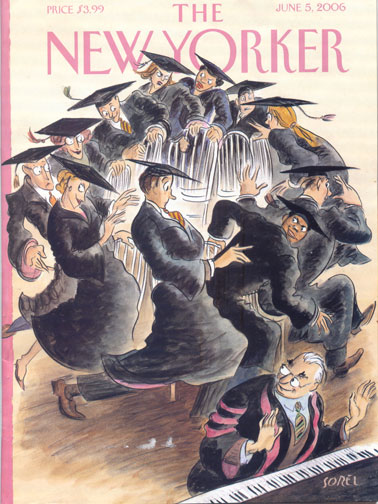
What Do You See in This Cartoon?

New Yorker Cover
New Yorker Cover: What Do You See in It?
  1. What was your reaction when you saw this cover?
  2. Are you familiar with the New Yorker and its covers? Do you think that influenced your reaction? If so, how?
  3. After further reflection, did you see something different than your first reaction, or did the details of the picture just reinforce your original idea?
  4. Please share any other thoughts on this cover that you may have.

I’m not going to get into my own opinion of it yet because I want your honest reaction not influenced by what I think. So, readers, I urge you to look at the picture and then comment without reading other comments or visiting the original post. Of course, if you want to make a second comment for after you’ve seen other people’s opinions, I think that would be awesome, too.

Via Alas, a Blog.