Is gender inclusive game design important?

Q: Is gender inclusive game design important?
A: Yes.

For anyone familiar with my blog, you’ll know already that I take the above answer as a given in most of my posts. But today I got an e-mail from my sister. She’s taking an Online Games Seminar for her law degree (you know, if they had more classes like that I might be persuaded to go to law school after all…) and gave me a link to one of her required readings: Playing with Fire: When Advergaming Backfires.

Her request? That I write a short blurb on whether or not I think it’s okay to have avatars of only one sex in a game without a darn good reason. The short answer to that is, of course, is that I think it not only ruins gameplay (for women and men who like and respect women), but it also reinforces the “no girls allowed” message that we find in so many places in society.

Since I can never just be short and leave it at that, my long answer is behind the cut. Continue reading


Today's a day for link blogging

Q: What’s this all about?
A: Back in December, Rosie did a racist impression of the “Chinese” language. The following are some links from reappropriate which detail quite nicely this debacle. If you want more thorough coverage on the issue, I suggest you plug in rosie to reappropriate’s search engine, as Jenn has some good link roundups.

Some helpful links:
Rosie O’Donnell’s “ching chong” moment
Rosie O’Donnell’s Publicist Tells Asians to Get A Sense of Humour
Racism Abounds Following Rosie
Rosie O’Donnell Apologizes

Via Bonasi’s Realm….


Quote of the moment

From A couple of radical statements about sex, from the end of my rope.:

“But wait!” you may be thinking to yourself. “You’re on the record as having issues with objectification! Aren’t these sexy sex-having female characters exactly what you’re complaining about?”

And if you are thinking that to yourself, you missed the exit to the point about a hundred miles back.

Being a feminist, wanting to see better female representation in comics, and being uncomfortable with objectification is not the same as wanting to desexualize everything.

I like sex, I like sexy things. I’m human, with quirks and desires and all that other crap that comes with the territory. Not everything I like is going to be nice, or fluffy, or close your eyes and think of England. Sometimes, my mind’s downright filthy, and that’s just okie-dokie.

Via ariella drake


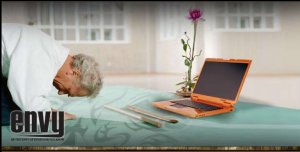
What's wrong with this picture?

Asiaphilia laptop style
Feel the cultural appropriation around us

I swear I don’t go looking for these kinds of things, they find me all on their own. I went to VoodooPC’s website to check their tech support hours (in the hopes of me getting my laptop back this century…) and I saw the above image.

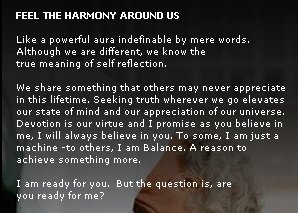
When you mouse over it you get this lovely text:

Feel the harmony?

Do I even have to do an image and textual analysis of this for everyone to understand what’s wrong with a North American company (recently bought out by HP, mind you) capitalizing on the fetishization of Asian culture in order to sell its product? Okay, then.

Honestly, if I didn’t have so many things to do already I’d be sorely tempted to make a satire of the above ad using Christianity. The laptop as Jesus, anyone?


A deeper look into femininity [The Gaming Beauty Myth, Interlude]

I’m labeling this as an “interlude” because the constructs of femininity I’m about to address don’t all directly intersect with the beauty myth, but the way that they interact with femininity as a whole is a topic that I feel needs to be addressed. I’ve been sitting on this one ever since Shannon over at Egotistical Whining wrote a commentary on the second part of this series.

In life, and especially in male-dominated areas, femininity gets a bad rap. It’s seen as frivolous, as emotional, as irrational, as naive… the list goes on an on. It’s not, however, seen as desirable to possess because it’s somehow lesser than masculine traits.

I’ve tried to dispel that false dichotomy in my series thus far, but it’s hard to see the bigger picture when the topic at hand is the beauty myth, a cultural paradigm that relies on ruthlessly exploiting the negative aspects of femininity in order to maintain the connection between women and sex. So I’m going to try here again to illustrate why, exactly, despite its flaws it’s not in our best interest to throw femininity into the same trash bin as the beauty myth itself. Continue reading


Theory Link for the Academically Inclined or Interested.

For those who may be interested in academic journals and and don’t already have access for other reasons, Sage Publications is currently offering some Free Trial Online Access, which includes free access during February to all online journal archives, and free access to selected other journals for longer periods (including their ‘Gender Studies’ collection). With journals like Men and Masculinities, Indian Journal of Gender Studies, Race and Class, and Games and Culture among a long list, I could be here for days. I’m so glad I cleaned out my hard drive recently.

Full List of Journals can be found here. Details of the Free Trial Access can be found here.


Childcare in Australia

So, the media here has been all over a recent report released by the Federal Treasury Department that supposedly counters years of claims that there is a childcare crisis in Australia, and claims that childcare is ‘accessible and affordable’. One of the key claims is that there’s oodles of childcare available to parents, “just not of their preferred type”.

Now, I’ll admit to not being an expert on childcare, particularly since I was never in childcare (I was lucky enough to have my grandmother move to Australia from my mother’s country of birth, China, when I was a toddler, so she looked after me when my mother went back to work), and I have no children, so I’ve never had the need to access childcare. Maybe I’m just being strange, but childcare always seemed like something one should be able to exercise a reasonable amount of discretion over, given, y’know, you’re trusting these people with the care of your children. Basically, the report claims that the perception of a childcare crisis is masking the fact that parents just aren’t getting the type of childcare they want, and there’s no mismatch between supply and demand. I mean really, it sounds like “People who want Coke are having trouble getting Pepsi, and people who want Pepsi are having trouble getting Coke, but there’s lots of cola, so there’s no supply/demand problem.” except with something that I’d like to think is rather more important than cola preference. Now, even with my rudimentary understanding of supply/demand, which mostly comes from my partner, who’s a marketing academic, I’m not seeing how that’s NOT a supply/demand problem. Really, as far as government reports are concerned, I’d see it as a reason to encourage further research into what kinds of childcare are lacking and wanted with reference to other specific variables, like location that’s more specific than ‘urban/inner-regional/outer-regional’. Unsurprisingly, instead we’ve got a bunch of handwaving and data-massaging in order to pretend there’s not a problem.

As for affordability, the report goes from “affordability has remained fairly constant for middle and high income families, and decreased slightly for low-income families” in the bulk of the report, to a blanket statement about child care being generally affordable. Those more knowledgeable in this area are free to correct me if I’m wrong, but I’d think that affordability of child care was a particularly crucial factor for low-income families, given affordable and accessible childcare is likely to be fairly important if one is attempting to increase one’s income above poverty levels. I imagine it’s rather difficult to get a second (or third, or fourth) job, or get more training if you can’t afford to have your kids looked after whilst you do that. So, y’know, if anything, I think the decreasing affordability for low-income families outweighs the stability for middle and high income families. Now, the report does indicate that the data doesn’t account for a recent expansion of a government-provided childcare assistance payment for low-income parents, but I’m not really a fan of the assumption without exploration that this expansion would sufficiently address the problem. If later research indicates the further government assistance is addressing the problem, that’s great, but the assumption is just lazy undeserved pats-on-the-back.

Now, the television reports have taken great joy in summarising the report as claiming parents are being picky. Whilst I think the report is more subtle than that, the ‘picky’ claim will probably pick up a lot of momentum, particularly from conservatives. But honestly, particularly given the amount of criticism that’s often thrown at women if their children are in childcare at all (unsurprisingly, men get much less of this criticism), I’m not really seeing why being picky about where and how your children are looked after if you need to work/study is such a horribly bad thing.
IMPACT Defense Against Multiple Assailants class

Good afternoon, Shrub.com!
My name is Katie, and I’m a white cisgendered female heterosexual able-bodied blogger.

Andrea gave me a Shrub login a few weeks ago so I could post ideas that I thought fit the thoughtful “breaking out of roles we’re supposed to have based upon our social categories” theme I often see here. I never did post the original piece I meant to, but it wasn’t critical. This is. Everyone should know how to defend his or her body to the maximum extent he or she can, and those who know owe it to those who don’t to responsibly pass on whatever they can by word of mouth.

Therefore I’m reposting here a summary of my experiences in IMPACT’s “Defense Against Multiple Assailants” course. (If you want more details about “defense against a single assailant,” click here.)

I look forward to hearing your comments and engaging with you here on Shrub.com for a long time to come!

     Fighting multiple unarmed assailants bore some similarities to fighting single unarmed assailants. Firstly, the premise of the attack was sexual assault or some other act that implied the assailants wanted you alive and aware of what they were doing until they felt that they had managed to perform this act. Therefore, assailants were more likely to grab and restrain us than to throw a deadly punch.

     As in Single Unarmed Assailants class, the presumption was that they were out to

  1. convince us to stop hitting them but not “fight” the way men fight each other and
  2. do sexual things we didn’t want them to do (or, as I said, something like that).

     This class is not adequate preparation for fighting multiple henchmen in a Jet Li movie whose only goal is to kill you as fast as possible.

Multiple Padded Assailants

Continue reading