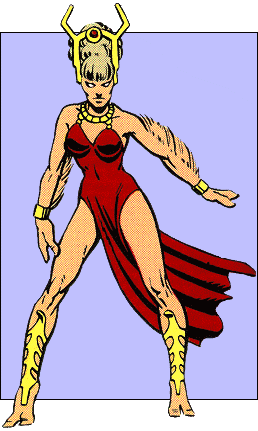
Please, Marvel, I’ve never read the pertinent comics and I don’t know what kind of character she was, but please bring back Gazelle in all of her 5ft. 9in., 145lb, hairy-armed glory:
Via: Ilyka Damen.
Please, Marvel, I’ve never read the pertinent comics and I don’t know what kind of character she was, but please bring back Gazelle in all of her 5ft. 9in., 145lb, hairy-armed glory:
Via: Ilyka Damen.
Sorry I haven’t been posting. I actually have a few in mind, but it’s the end of semester crunch right now so I’ve been immersing myself in Japanese.
A small study done by University of Florida professors recently was highlighted by MSNBC because of an award it won. Although the study itself is not proof of anything on its own, it seems to have opened up the debate on the assumptions of marketing and will hopefully bring to light other research done on this matter.
To this end, I’d like to highlight a new to me blog called Marketing to Women Online. Holly has written a piece called Do Women Respond to Sexual Ads? where she says:
We’ve certainly seen how different genders react differently to advertising messages. What women want and are attracted to can be different from what men want and are attracted to. This is not true in every case, but depending on the subject matter, the differences can be striking.
Sex is one such subject matter. I’ve written before about studies on how men and women react differently to sex in advertising.
Now there is another study with similar results. Do fashion magazine ads that ooze with pictures of sexy seductive women work? Especially magazines ads aimed almost 100% at women?
Via The Hathor Legacy (another great blog new to the blogroll).
Welcome to the Fourth Edition of the Carnival of Feminist Science Fiction and Fantasy Fans! We’ve got quite a collection here this time, a whole host of topics organized by medium: Comic Books and Novels, Film and Television, and (my favourite) Video Games!
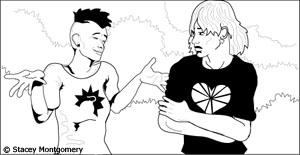
Starting this edition off with a bang are two posts talking about comic books in general. First, reappropriate‘s Jenn entertains us with her post, Meme: the Comic Book version.
Peachblossom of A Libertine‘s post, Feminist Superhero Books, talks about how the issue of feminism in comic books was tackled in the book, Wonder Women: Feminisms and Superheroes, by Lillian s. Robinson.
This one is a bit old, but it’s too good to leave unremarked on. Elkins of Notes from the Tundra examines the very real problem of girl on girl hostility in fandom and the world at large with her post Paranoia in Online Fandom: CMC, Girls’ Aggression, and Overanalyzing the Texts.
My assumption about this paranoia and the behavior that it engenders always used to be that it was simply a side-effect of the nature of CMC itself. The other week, however, while I was at the beach, I read a book someone had recommended to me on the subject of girls’ particular modes of aggression–Odd Girl Out: The Hidden Culture of Aggression in Girls, by Rachel Simmons–and it was really shocking to me just how well many of the things that this book described were things that I strongly associate with online fandom dynamics. That in turn has made me wonder to what extent much of the “paranoiac” behavior that I’ve been seeing in on-line fandom might be an artifact not only of CMC, but also of the predominantly female demographics of the fandom circles in which I’ve travelled.
Ampersand of Alas, a Blog connects this phenomenon to the feminist blogsphere at large in his post, How Girls Express Aggression and Online Fandom Dynamics.
In another instance of relating comics and feminism (this time with a superhero twist), this one Charlie Anders of othermag comments on a talented artist who is using comics as a medium to explore the anti-trans policy of Michfest, a popular women’s festival. The post, Superheroines team up to fight the real enemy, is worth a read, but don’t forget to check out the comic itself as well. It should be noted, however, that since the publishing of the comic, the festival that is alluded to has changed its policy and is now inclusive of all women.
 Moving away from independent comics and into the world of The Big Two, Kalinara of Pretty, Fizzy Paradise says that she can’t find it in her heart to hate someone who brought such a touching moment of female solidarity in Darn You Geoff Johns.
In the wake of both the wedding between the X-Men’s Storm and Black Panther, as well as the Black Panel at Comic Con, it’s no surprise that bloggers are still talking about issues surrounding gender and race in comics. Starting us off is Ragnell of Written World and her post, It’s still bothering me…, where she writes about her disappointment in the way that the more popular Storm has taken a back seat to Black Panther. She continues her analysis of this issue over at Newsarama by discussing the implications of the cover art in her post, Amateur Art Appreciation: The Groom
Tackling the issue head on in her livejournal, I’m Sorry I Haven’t A Clue, spiralsheep discusses sexism towards black women in comics in her post, In which our heroine asks, “What would T’Challa do?” , she has this to say:
But when a writer takes an achievement, a genuine victory, away from one character and gives it to another then there’d better be a good reason, when a writer takes away a female character’s self-determination and gives it to the men around her there’d better be a good reason, and when a writer turns a black victim of white crime into a black perpetrator of crime against a white person then there’d better be a !%@%! good reason.
The eponymous blogger Tlönista has written, Rebels from the waist down, a post on the portrayal of women in her favourite dystopian novels:
It gets scary-depressing when you read the feminist blogs and take in a piece on Joe Francis one day and teen virginity pledges the next and realize that the pressures on women in 1984 and Brave New World still exist simultaneously here, so that resisting one is giving into the other.
And what better way to end a section on comic books than with everybody’s favourite hero? Yes, that’s right, Planet Karen has a very special strip about Mars.

Over at Real Men Are Not, Luke dissects an essay on “Fembots” in his post, We’ll Pick You Up: Fembots and the Idiot at Enterprise [eta – broken link removed].
I don’t care if you say that fembots are some male-created extension in science of an already patriarchal culture but don’t tell me that that’s really the “perfect male fantasy”? Talk about something original and actually news-worthy.
Superwomen, not Fembots, are the subject of Ide Cyan’s post over at Feminist SF – The Blog!. In My Super Ex-Girlfriend [Caution! Spoilers in link.] she explores the movie of the same name from a feminist perspective.
The use of oversensitivity to sexual harrassment in the workplace as a running joke is particularly odious and tiresome. In the mouth of the protagonist’s Black, female boss, it adds to the caricature of women in positions of power as unreasonable and unjust towards the poor hapless (White) males.
 And We Shall March laments yet another bastardization of Leguin’s Earthsea series in the post, And Then Ghibli Screwed Earthsea.
What sci-fi carnival would be complete without some Trekkie-loving? First we a post on the original series of Star Trek: heavenscalyx of The Calyx of the Heavens touches on (among other things) the treatment of Marla McGiver in, Khaaaaaaaaaaaaaaan! But TOS isn’t the only of the Star Trek series deserving of attention! On the Hathor Legacy, a blog devoted to the portrayal of women in the media, Revena discusses the fluid gender expression of the character in Star Trek: Deep Space Nine – Jadzia’s Gender.
Kirylin of Kirylin’s Voice muses on Traits of a strong female character, looking at shows like Buffy the Vampire Slayer in contrast with shows of her youth, like G. I. Joe:
Thinking about Elisa; Gloria and Vanessa; Lady Jaye, Scarlett, and Cover Girl; R.C.; Tea and Alexisa… it makes me wonder what defines a “strong” female character.
And to wrap things up with this section, another post from Charlie Anders at othermag: So much for the feminist take on Doctor Who [Caution! Spoilers in link.], which discusses the relationship between the Doctor and his companion.

Jeff of our very own Shrub.com kicks off this section by questioning why “feminist video games” didn’t pull up any matches in his post, Feminist Video Games?
Of course, there’s the larger question of what would make a game good from a feminist perspective. In addition to being good from a gameplay perspective, I’d say such a game would include female characters who are full agents in the game world, and who are treated as subjects rather than objects. I think a variation of the Mo Movie Measure applies as well, in that female characters should interact with other female characters in ways that aren’t centered around men.
And, speaking of feminism and games, you know it’s going to spark some controversy when Sony announces that it’s going to release a pink console. Ariel of New Game Plus discusses the politics of pink PS2s and PSPs in her post, Feminists and Pink Game Consoles.
In a more personal expression of feminism and video games, Brinstar of Acid for Blood asks her readers to help her live like a pro-gamer for a weekend in Send Me to Stockholm.
So why do I want to go to Stockholm to learn how to play FPS games with a professional Quake 4 clan? Because it sounds fun. I’d totally blog about it, too. And there would be pictures.
In a less personal post, Brinstar looks at the gender differences in the survivors of a new video game in her post, No Weapons for Women in Dead Rising. While all of the men players have encountered thus far will take a weapon to defend themselves, most women are offered a hand and ushered off to safety. Although I doubt anywhere is truly “safe” when zombies are involved.
And on an unrelated subject, in response to an e-mail I received, I call for readers’ opinions on the where they think the responsibilities of privileged groups lie when choosing avatars in roleplaying games. My post, Race and Video Game Avatars, is on Official Shrub.com Blog and is reproduced over at Alas, A blog, so be sure to check out the discussion at both sites.
This concludes the Fourth Edition of the Carnival of Feminist Science Fiction and Fantasy Fans. Ragnell is hurting for hosts, so please e-mail her here and volunteer!
According to a BBC News article, Games industry is ‘failing women’, girls don’t want girly games about makeup, they want girly games about relationships and chatting. Or something.
The chief operating officer for EA’s worldwide studios, David Gardner, had this to say on the matter:
They don’t want ‘pink games’. Thy are not trying to play girly games where Paris Hilton and Britney Spears go shopping and put make-up on.
[…]
The Sims is really a game about relationships – and that’s what girls want – they want relationships, they want to be able to chat.
Really, I’m thrilled that the video game industry is finally realizing that it has a vast, untapped market. But, picking and choosing stereotypes instead of realizing that women and girls, like men and boys, are people with varied tastes and preferences really isn’t the way to do it.
I mean, am I the only one who sees the logical disconnect between saying that girls don’t like “girly” games, and then pulling out the relationships and chatting stereotypes as the reason why many women play The Sims?
Could it, perhaps, be that the afforementioned “girly” games are stupid and badly made, while The Sims has a solid background and has had lots of thought put into it? Or perhaps that The Sims affords you a chance to play God, not only by controlling your sims, but also by downloading and even creating new content. There’s even the possibility that it attracts women because it’s not specifically marketed against us — if any objectification goes on, it’s completely player generated, rather than company generated.
I can see people playing it because they like forming (and breaking) relationships. That has been one of the fun aspects for me, too (as is amassing wealth, turning my characters into vampires, having my sims have more sex than I do, downloading cool stuff, etc). That Gardner would bring up “chatting” as a reason more women play The Sims, though, tells me that not only does he not know his company’s product very well, but he’s relying on stereotypes rather than actual evidence. The Sims is a single player game, the “chatting” that goes on in it is that you can click on a sim, select “chat” and they’ll speak in Simolean. Which is not, by the way, a real language. I hardly see that as qualifying.
Marketing towards women based on stereotypes isn’t working, the “girly” games that are cited as failing are proof of that. So, please, video game companies, stop cribbing off of my Top “Geek Girlâ€-Friendly Rules! list and start viewing your potential female consumers as a vaired and diverse group of people — you know, how you view your male audeince (save the teenage group, who you seem to think are sex-crazed, misogynistic, annoying and stupid children; while we’re at it, stop that, too).
I recently received an e-mail from a OS.CB reader regarding choosing a human character of a different race to play in a video game. The letter is as follows:
I’ve been struggling with coming up with an answer for this question, so I thought I would ask for your opinion on the matter.
As I was playing World of Warcraft, I decided that I would like to make an Alliance character. Sifting through the options, I chose to play a human mage. Being human, you can choose from a variety of skin colors. This is where the anxiety began for me; I really liked the look of having a black female mage. I had zero intentions of stereotyping her in any way; I just liked how she looked.
It comes down to this: as a white woman, I was too afraid to create a black character. I was afraid that I would be called racist, or accidentally offend people. My question is this: Can I, as a white woman, play a black female character, or is that too offensive?
I have done the same in Oblivion; I shy away from creating Redguard characters because I feel I don’t have the right to play as a black character.
I just wanted to hear your thoughts on the subject.
Video games often give us a way to explore different aspects of ourselves. When we’re given a choice over character development, oftentimes we will choose avatars that are in some way different from our “mundane” personalities. I have, in the past, criticized men who play as women, but I think that the important deciding factor in whether or not having a woman avatar is sexist lies in how the female persona is treated, not in the gender of the player. I think it’s important to ask questions such as: Has she been picked because she’s a hot piece of ass? Exotic in a way that a male couldn’t be to the player? Roleplaying wise, has she been picked to play The Girl, or is she a well rounded character who happens to be female?
My first thought on the matter of race would be to treat it as much the same thing: choosing a human character of another race is not inherently wrong, but it can become offensive if you treat that character like The Other. But, of course, I have the same dilemma that my reader did: as a white person, I’m coming from an outsider’s perspective and so I’m not in a position to judge if, in fact, the two situations (a man playing as a woman, or a white person playing as a person of colour) are comparable in any significant way.
So, with this reader’s permission, I have decided to post the question to all of you: What do you think of a white person picking for their avatar a character of colour that’s clearly relatable to real life racial delineations and does this change when discussing a fantasy race that doesn’t have clear correlations to real life?
My sister’s getting married tomorrow, so I’m in Seattle for the weekend (paying to have hideously expensive internet for the night). I’ll be back for real on Tuesday.
So, first the good points: Ariel came down to see me and we had a fantastic night. We did a dinner theatre thing, which was fun and funny.
My sister’s fiance got set up by his dad to be one of the “victims” of the performers, Kevin Kent, who was dressed up in drag as “Cookie” (I’ll be using female pronouns for Kent/Cookie, as the character was female). So, Cookie decided that she was the “Goddess of the Hunt” and that my sister’s fiance was her prey. She took off his shirt and put him in this fuzzy hat with antlers.
He, of course, hamming it up as he loves to do, got completely into the act. She told him to “die” after she shot an arrow into his heart, and he fell to the ground, after which she added, “…and fall onto my bosom.” To which he got up and face planted into her cleavage obligingly.
For the final part, Cookie told him to give her a kiss. Seeing as most heterosexual men, especially those about to be married, wouldn’t kiss another man (no matter how fetchingly dressed in drag he was), I’m guessing that Cookie intended to involve my sister in it somehow when her fiance inevitably balked.
I, however, knew him better than that. And, lo, he brazenly dashed into her arms and planted a kiss right on her lips. It was a moment that none of us will forget, and I’m betting that’ll include Cookie, who was just as stunned as my sister’s fiance’s family.
Now the bad: Mom, who hasn’t been able to spend the time with me this trip that we both wanted, asked if Ariel and I would walk to the hotel with her instead of taking a cab. Thinking nothing of it, we agreed. It’s a nice night, Seattle is beautiful in the summer, and it’s not like I don’t walk twice the distance in my daily life in Okazaki.
Point 1: When I informed Dad of our intention of walking, he started up with the rape culture stuff. “Are you sure that’s a good idea? It’s late and you’re all painted up… I’m not sure it’s safe. Are you sure you don’t want to get a cab?”
I mean, of course he’s worried about me, especially since he lives in Miami where you can’t walk down the street in broad daylight wearing baggy jeans and a long t-shirt, with your hair all mussy without every single car containing at least one man whistling at you as they drive by. But holy fucking shit, can I not go one day in my damn life without feeling the constant fear of having been born female? Like, seriously?
Which brings me to Point 2: I’m walking with Ariel and my mother, and we pass a group of guys. Inevitably, they start up with the “hey there pretty lady” shit (sorry, Luke, none of us had picture phones available, so we can’t Hollaback). Did I put my money where my mouth was and say something pithy to them? No, of course not. I shot them a dirty look and kept walking.
I could make up a thousand excuses as for why (they wouldn’t have listened to me, we had to get home and it was late, etc etc), but the truth is that I was scared. I was afraid that they’d hurt me, or Ariel, or my mom. I was afraid they would chase us, or continue harassing us, or pull a weapon on us. I was afraid that Dad was right, and it wasn’t safe, and I was an idiot for walking the 10 fucking blocks to my hotel.
And that wasn’t the only harassment we got. This one older white guy in a grey shirt that said “army” on it walked past us and held out his thumb to me like he was trying to hitch-hike. I have no idea what he was trying to say with that one, but it creeped me out.
I feel so demoralized right now. I feel like if, at the end of the day, all my talk doesn’t even help me stand up to the creeps on the street, then how do I expect to help anyone else out on these issues? What’s this all for if we can’t even walk somewhere — dressed up or not — without men feeling it’s their right to “compliment” us by harassing us. I should be able to walk down the fucking street at night dressed however I like without men assuming that I’m doing it for them and that they have the right to threaten me, and give people like my father cause to try to dissuade me from doing something — like walking instead of driving — that gives me personal satisfaction.
At first glance, it would seem that the push for modesty is at the opposite end of the spectrum from “raunch culture” — the trend in society to hyper-focus on sexuality (particularly women’s sexuality), which encompasses everything from short skirts to athletes posing in porno mags. Indeed, those who crusade for modesty often cite expressions of raunch culture as why people (mostly women) need to “cover up,” and there are many aspects of raunch culture that can be attributed to a backlash against forced modesty.
But, what if they were just two sides of the same sex-negative coin? What if they were just two different ways of controlling women’s sexuality? Looking at it another way, isn’t it just a new spin on the Madonna/Whore complex?
When I talk about “modesty” here, I’m not talking about people who prefer to dress in a more conservative style. I’m not talking about people finding baggy shirts more comfortable, or those who favour pants over skirts (I would be one of them, although I’m re-thinking that given that Japan summer is really hot). Nor am I talking about choosing not to wear makeup. When I talk about “modesty”, I’m not talking about the way we, personally, choose live our lives, but rather the cultural push for “modesty” and the baggage that comes with it.
The primary idea behind modesty is that the human body should be covered up for reasons other than warmth or fashion. In modern Western culture, it is often (but not always) supported by religious arguments, which interact with the secular ideas of gender essentialism. Often there is an undercurrent of disgust for the human body, as well as an objectification element, especially when it pertains to women.
At best, women are told that they’re “unprofessional” if they don’t fit some arbitrary version of modesty, at worst it’s used to blame them for transgressions comitted by men. We’ve all heard the “short skirt” defense for rape, and that’s just the most visible of the “boys will be boys” arguments. Some of the more extreme proponents of modesty campaign against not only “raunchy” clothing that emphasizes cleavage and/or butts, but also tank tops, shorts, and bikinis because they show a lot of skin.
Modesty, as it is pushed in Western society, relies on defining for people what parts of their bodies are, and are not, acceptable in public, or even semi-private places. It uses tactics of shame and guilt in order to force people to comply with its guidelines, and in many cases “modesty” guidelines are part of laws (ex. many states still hold that a topless woman is indecent, whereas a topless man is not) and dress codes. In that way, it is very much a part of, and a method of perpetuating, a sexually negative culture.
There are a lot of aspects of sexual culture that we, as individuals, can find as liberating. In a very personal way, I can understand how freeing it can be to give a big middle finger to the “morality police” and wear clothing that I choose because I want to wear it. After a year of being forced by an abusive boyfriend to wear the shapless, baggy clothes of his choosing, I’d have to say finally being free to figure out my own style definitely counted as “liberating” for me. Now if I choose to wear my “boy” shirts and “boy” pants, I know it’s because I want to, and I know that tomorrow I could just as easily choose the cleavage shirt and short skirt that lives next to it in my closet.
That said, just as the choice to adopt “modest” dress does not live in a vaccum, neither does the choice to wear “revealing” clothing. There is a lot of pressure on young girls to adopt a particular style of dress. Now, there’s a lot of pressure in every subgroup to adopt the clothing style, as well as the lifestyle, and men are subject to that, too. But take that, and add it to the pressure for women to enact being “sluts” while still (mostly) remaining “virginal” and commercialize it by having visible female role models hawking it, popular culture normalizing it, and the “moral police” making it taboo (and therefore more enticing) by saying, “no, no, no, that’s bad,” and what do we get? Well, as Ariel Levy puts it, “What we once regarded as a kind of sexual expression we now view as sexuality.” (Female Chauvinist Pigs, p. 5)
But what, exactly does this brand of sexuality say about the concept of sexuality if it is, indeed, sold as the expression of female sexuality? Just like “modesty” puts the onus on women to cover up, so does “raunch culture” put the onus on women not to cover up. Female sexuality is turned into something that is primarily for entertaining the men, and if a woman says that she isn’t into that kind of exhibitionism then she is often labeled as “prude,” or “frigid,” or “puritain” (I got that one when I was younger, joy of joys), or some other implication that she is somehow bad for not submitting to being an object of their lust.
Raunch culture guilts and shames women into putting on a sexual performance for men, whether they want to or not. It sets up a “right” way to express sexuality, and by pushing the notion that men are entitled to sexual gratification, even if it’s just in the form of women wearing low-cut shirts, it ignores the fact that true sexual liberation comes from people being able to make choices about what makes them happy without being guilted and/or shamed into acting a certain way. In that way, it is very much a part of, and a method of perpetuating, a sexually negative culture.
One aspect at the heart of sexually negative culture is holding women responsible for men’s lust. Modesty, for its part, claims that women provoke men’s lust*, this is bad, and therefore women should be covered up so as not to “tempt” the men. Raunch culture may see men’s lust as a positive, but in this case the response is to encourage women not to cover up, because men’s lust should be catered to. In both of these scenarios, two positions that take the opposite side on an issue (men’s lust) do it from the same frame: that women’s sexuality is the province of men, not the women whose sexuality it is. And that, at least for the women involved, is sexually negative.
* Just to be clear here, I’m using “men’s lust” to mean the dominant paradigm for men’s lust that’s used in these cases, which includes the idea that men are entitled to sexual gratification, that to get off they need to objectify and dehumanize women, and that this is not so much a “bad” thing as it is a biological “fact.” I’m perfectly aware that the reality of what men do, and do not, find attractive is a much more complex subject.
The 3rd edition of the Carnival of Feminist Science Fiction and Fantasy Fans is up at New Game Plus. There’s a broad scope of issues from television to video games, and I would highly recommend checking it out.
On that subject, I’ve been suckered into volunteered to be the host for the fourth edition, to be put up on August 25. That means that it’ll be available both on OS.CB and Alas. The suggested writing theme is feminist utopias and dystopias, but (as always) you’re free to write on anything that fits into the official guidelines:
- All Weblog Postings on Science Fiction and Fantasy works in all media (books, comic books, television, film, roleplaying tabletop games and video games) written from a Feminist Perspective are eligible.
- Fan fiction written from a Feminist Perspective is eligible.
- Posts about fan fiction written from a Feminist Perspective are eligible.
- Posts about conventions and fan gatherings of a Feminist nature are eligible.
- Posts about conventions and fan gatherings written from a Feminist Perspective are eligible.
- Posts about any science fiction or fantasy fandom written from a Feminist Perspective are eligible.
- Posts linking to newsand announcements are eligible, so long as they pertain specifically to the Feminist Sci-Fi Fantasy community.
- Considerations about science fiction/fantasy news from a Feminist Perspective are eligible.
- Analysis of non-Feminist works from a Feminist Perspective are eligible.
- Rants about any of the above written from a Feminist Perspective are eligible.
- Posts which spell “Space” using 3 A’s and two exclamation points and are written from a Feminist Perspective are eligible.
- Posts about Green-Skinned Amazons (from Outer Spaaace!) with more than two breasts that are not written from a Feminist Perspective will not be eligible (and if they aren’t damned funny,* will be reproduced for mockery).
- Posts about Getting Your Girlfriend into [specific type of fandom] had also better be damned funny. If written from a Feminist Perspective (even tongue-in-cheek), they will be eligible.
Submissions are due by Wednesday, August 23, and can be mailed to me here (please use the subject heading Feminist SF Carnival) or submitted it via the Blog Carnival form.
And here I am talking about race… again. I have all these beautiful posts on gaming started, but then I see things like nubian’s interview over at feministing and I feel like I have to say something. Whenever posts from feminists of colour talking about their experiences as feminists of colour get linked, invariably at least one person (sometimes another feminist, sometimes not) turns it into how the feminist of colour is mean, bad, racist, whatever.
I’m ashamed to admit it, but it still surprises me how easily the tables get turned on the feminist of colour. How easy their righteous rage, their justified anger, is presented — and accepted! — as them unfairly attacking white feminists/women/men. I just see the smooth 180 and it boggles my mind. Does no one besides the women being attacked see the ridiculousness of privileged people crying, “help, help, I’m being oppressed!’? Does no one see how it’s used to derail the thread from productive conversations?
In the interest of time (and my sanity) I’m just going to examine two of the many ways this happens, using the feministing thread as a case study. But don’t be fooled — nubian may be the most recent victim of this phenomenon, but she is far from the only one.
I’m sorry Nubian, I have just one word for you:
Hypocrite.
[From Nubian: Blogging While Black, comment by MsJane]
MsJane calls nubian a hypocrite for expressing anger towards white feminists — anger that we don’t get the same hatred heaped on us and anger at the way we often ignore the very real, and very important, experiences of people of colour. In the course of the comment, MsJane uses the same harsh language that she faults nubian for, using words like “pompous,” “nasty,” and very condescendingly saying that she’s “sad” that nubian ‘chooses’ to “create divisions and make mocking statements.” Not to mention using the passive agressive method of saying that some people (ie. nubian) have to grow up. Come on, now.
I will be the first to admit that the balance between anger and viciousness is a hard one to find. We’ve all stepped over the line at some point, but I honestly believe that this case is different. What nubian, and every other feminist blogger of colour I’ve read, are being lambasted for in these instances is really that they call us out on our privilege and we don’t like that.
These days, it seems like whenever nubian’s name comes up, someone has to step up to the plate and start whining about how nubian said something mean. It turns nubian into the bad person. I’ve seen it happen with other bloggers of colour, like the time Jenn was practically called a race traitor because she dared to speak about sexism in the Asian American community.
I don’t see this being any different than when I rant about the “boy’s club” of video games, or comics, or whatever. I get men who want to do anything except for question their privilege coming over and calling me names, calling me a hypocrite, doing anything they can to discourage me from posting more on the issue.
Suddenly, I’ve become the bad one and they are the wronged party. Wait… what? I’m the one who has to see her gender objectified, who has to put up with being sexy first and a geek second, who has to deal with a hostile environment trying to keep me away from doing something I love. All they have to put up with is a woman huritng their feelings by being angry at her lot, which is only a momentary annoyance before they go back to the culture that caters to them.
But, I’ll admit that it’s a great method for derailing the thread — instead of talking about the subject, the thread is inundated with people defending or supporting what amounts to ad hominem attacks.
I’m tired of people writing, “I’m a White feminist and I’m learning so much from you.†And I want to write back and be like, “I’m not here to teach you!â€
[From Nubian: Blogging While Black, quote from nubian]
MsJane, who I referenced in the previous section, also takes issue with this. She brings out the “we are all teachers” argument, which is all fine and dandy if you don’t mind having privileged people come up to you and say, “Show me the oppression!” Even times and places where I’ve chosen that role I get tired by the assumption that I’m somehow responsible for thinking for them. Being a good ally involves not trying to foist responsibility onto the oppressed group with weasely phrases like, “we’re all teachers,” when it’s clear that the onus is disproportionately on the individual and/or group you’re talking to.
Furthermore, given her tone, I’m going to go out on a limb here and say that the impression I got from what she said was that she was more affronted that nubian dared to slap white feminists’ wrists for trying to say something nice. And, hey, the first moment that I read what nubian wrote I was like, “Why’s she complaining about taking a compliment?!”
But I took the time to read it again, read it in context, to think about what I know about nubian and her blog. And I realized that getting angry that she’s tired of being patted on the head by white feminists for being a good little token is just as condescending, if not moreso, than when guys force their chivalry on me (without my wanting it) and then expect me to be thankful. Fuck that shit.
Instead of getting angry at nubian for calling us out, we need to be truthful with ourselves: if we’re turning bloggers of colour into The Teacher on racial issues, we’re doing something wrong. If we tell her that we’ve “learned so much” from her and then expect her not to be angry, then maybe we haven’t actually learned that much at all.
True equality requires giving something up: our privilege. Until we’re ready to do that, forget equal wages or any other equality.
[From Nubian: Blogging While Black, comment by luci33]
There is a fundamental difference between a person speaking as a minority, on a minority issue, and being angry about it and a person speaking as a privileged person, from a position of privilege, being angry about a minority issue.
Power.
Privileged people have it and we use it, mercilessly, in order to prevent any conversations that may lead to us losing it. We use it to take a critique and turn it on the head; after all, it’s much easier for us to rally people against that oh-so-mean minority who isn’t being the proper token than it is for us to turn the harsh critique into something we can use to fight against a privilege-based culture.
I fully believe that we, as feminists, have a responsibility to see “oppressed as oppressor” line of thinking for what it is and not engage in it ourselves.
First off, sorry for the lack of posting recently. School has just stepped up a notch and I’m struggling to readjust. Next week my part-time job starts, too, but I’m hoping to get some quality posting time in this weekend. Anyway, onto the main event.
Claire of SeeLight has posted this excellent reading list for people interested in learning more about racial/ethnic issues. In the introduction, she says this:
All of these are sources of my knowledge and understanding, sources of my vocabulary. But, of course, I’ve done some study and reading as well, and I should be able to share some print sources with you. And because it’s amazing how difficult it is for a google search to occur to the ignorant (I’m complaining about myself as well; I’ll go halfway around the world to ask a friend a question before I’ll sit down and do a google search about something I’m ignorant of) here’s a non-threatening reading list of things that might help you share the current common understandings that shape the activist Asian American and Hapa spaces in the US today. Basically, I’m providing this (as my last post for IBAR) so as to give no one who reads this an excuse for not knowing. These are my reading recommendations. You can start here and let the reading itself guide you on.
She actually has a lot of great things to say in her introduction, so don’t just skip it and check out the books. Read the whole thing. I guarantee you’ll be glad you did.

Wow, that sounds horrifyingly awful. Even more than usual! (...)
[...] un nom est un privilège, une loi particulière, en (...)
29.It is not seen as sex discrimination to include harmful (...)
[...] Geek Feminism goes on to share this: Many people, (...)
Thank you for writing the most accessible introduction to (...)